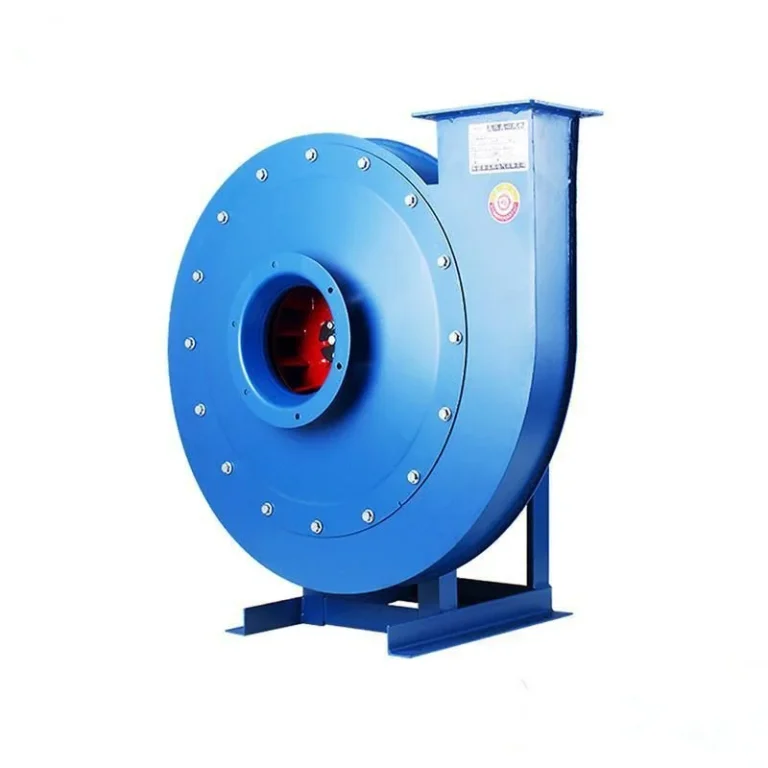
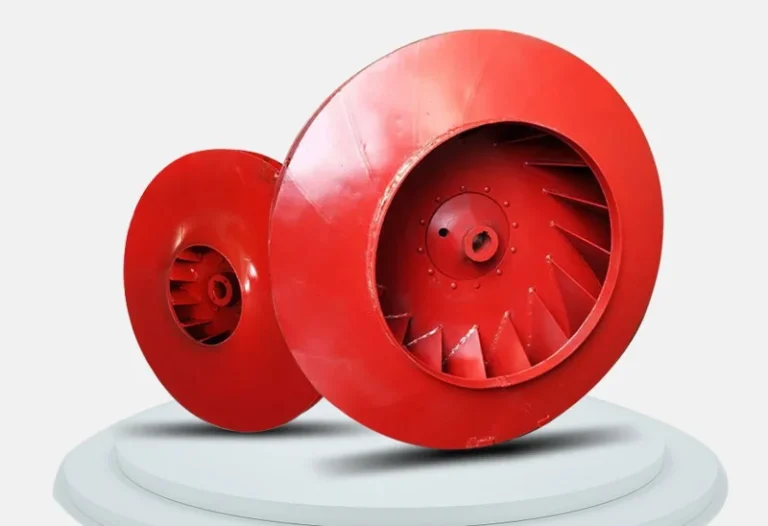
High Pressure and Low Pressure Centrifugal Fans
Pressure class decides impeller width, blade angle, casing thickness and price. How to tell which class a duty needs before a supplier picks for you.
Read More
There is no single centrifugal fan. The family splits by blade shape, by drive arrangement, by casing style and by pressure class, and each split changes how the unit behaves in a system. Two fans can share a mounting footprint and behave nothing alike, which is why picking by airflow alone goes wrong so often.
This is a working breakdown of the types you will actually be offered, in the order that matters when you are choosing: blade shape first, because it decides the shape of the fan curve; drive second, because it decides where the motor sits; casing third, because it decides how the unit fits the plant room.
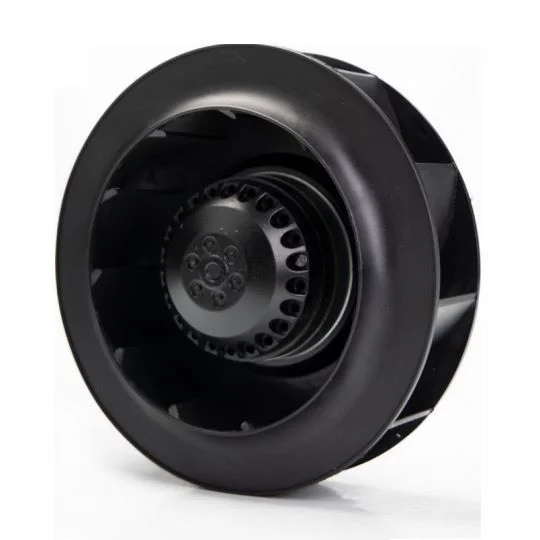
Blade shape sets the relationship between flow and pressure and determines what happens to motor load when the system resistance changes. Four shapes cover almost everything sold today.
| Impeller type | Pressure per stage | Peak efficiency | Behaviour when flow rises | Typical use |
|---|---|---|---|---|
| Forward curved | Low to medium | 55 to 65 percent | Power rises steeply, motor can overload | Small air handling, fan coils, compact blowers |
| Backward curved | Medium to high | 70 to 82 percent | Power peaks then falls, self-limiting | General ventilation, clean process air |
| Radial, straight blade | High | 55 to 68 percent | Power rises steadily | Dust, abrasives, high temperature |
| Aerofoil or backward inclined | Medium to high | 78 to 86 percent | Self-limiting, best efficiency | Large clean air duties, HVAC, boilers |
The forward curved impeller is the cheapest to make and the most common in small equipment. It moves a lot of air for its size but produces modest pressure, and because power rises steeply with flow, a forward curved fan running near its maximum flow can overload its motor. That is why they are almost always applied with a damper or a fixed restriction.
The backward curved impeller is the workhorse of industrial ventilation. Blades lean away from rotation, so as flow increases the power curve flattens and then drops. A backward curved fan can run at wide open inlet without burning its motor, which makes it forgiving to commission and safe to oversize slightly.
Buyers searching for a backward centrifugal fan are often unsure what is backwards about it. The reference is the blade tip angle relative to the direction of rotation. In a forward curved wheel the blade tips point in the direction the wheel turns, so the air is scooped forward. In a backward curved wheel the tips lean away, so the air leaves the blade at a slower absolute velocity but the casing converts that velocity into pressure efficiently.
The practical outcome: forward curved gives more pressure per millimetre of impeller diameter, backward curved gives better efficiency and a safer power curve. For anything above about 1,500 Pa or above about 2 kW, backward curved is the default.
When the air is dirty, hot or abrasive, efficiency stops being the priority. A radial impeller with straight or slightly curved blades has wide passages that resist clogging, and blades thick enough to survive erosion. The trade is efficiency and noise: a radial fan is typically 10 to 15 points less efficient than an aerofoil unit and noticeably louder at the same duty.
Our centrifugal exhaust fan range and the boiler fan series both use heavier impeller construction for this reason, and the kitchen exhaust fan uses a compromise design that tolerates grease while holding noise down to 67 to 74 dB(A).
Three arrangements cover nearly every unit sold.
The motor choice cuts across every other classification and is now one of the first questions in any specification.
An AC centrifugal fan uses an induction motor, fixed speed, driven from the mains. It is the cheapest option, robust, and easy to maintain anywhere in the world. Speed control is possible with a variable frequency drive or a voltage controller, but efficiency at part speed is poor.
An EC centrifugal fan uses a brushless DC motor with integrated electronics. It is 15 to 30 percent more efficient at part load, has a built-in 0 to 10 V or PWM speed input, and reports its own speed and fault status. Our EC backward curved unit delivers 311 Pa of static pressure at 3,096 r/min with 68 dB(A) noise from an 85 W motor.
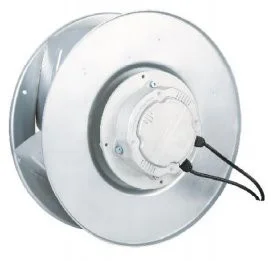
A DC centrifugal fan runs from 12, 24 or 48 V supplies inside equipment. It is the standard for cabinet cooling, medical analysers and telecom enclosures, where the DC centrifugal blower range covers pressure duties that an axial fan cannot reach in the same footprint.
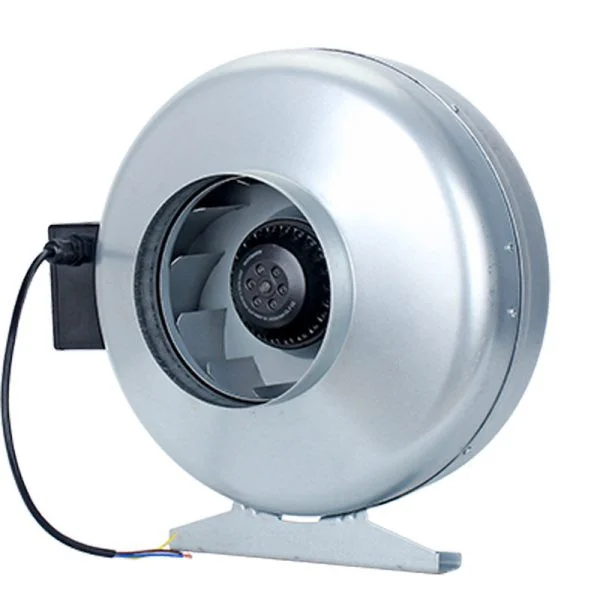
The scroll casing is the classic form and the one most people picture. A plenum casing wraps the impeller in a box and discharges through a face, which suits air handling units where the fan sits in a chamber. An inline or tubular casing puts the impeller inside a straight circular housing so the unit can be inserted into a duct run, which is how a tubular centrifugal fan achieves pressure like a centrifugal but installs like a duct fan.
Our turbo circular centrifugal duct fan is that third type: 170 to 1,200 m3/h, 68 to 451 Pa, 48 to 53 dB(A), sized from 100 to 315 mm to match standard duct diameters. It is the correct answer far more often than a box fan squeezed into a ceiling void.
A short decision path that covers most enquiries. Below 500 Pa with short duct runs, an inline centrifugal or a compact backward curved unit. Between 500 and 2,500 Pa, a backward curved industrial fan, direct or belt driven depending on size. Above 2,500 Pa, a high pressure impeller with a heavier shaft, as in our process air fan reaching 9,149 Pa. Dirty or hot air, a radial impeller with wear protection. Wide coil faces or air handling units, a double inlet unit. Tight enclosures, a DC blower.
Get the type right and the selection work is mostly arithmetic. Get it wrong and no amount of motor resizing will fix the system.
Neither is universally better. Forward curved is smaller and cheaper for a given airflow at low pressure, and is standard in small air handling equipment. Backward curved is more efficient, quieter per unit of pressure and safer against motor overload, which is why it dominates industrial ventilation above about 1,500 Pa.
An AC fan uses an induction motor at fixed speed and is the cheaper, simpler option. An EC fan uses a brushless DC motor with integrated electronics, giving part-load efficiency 15 to 30 percent better and a built-in speed control input, at a higher purchase price.
Only if the impeller can run at the motor’s speed and still meet the duty. A direct drive conversion changes the fan speed, and with it the flow, pressure and absorbed power. Any conversion needs a new duty point calculation, not just a new motor.
It is as good for its purpose, which is fitting into a duct run with limited space. It typically reaches lower peak pressure than a scroll unit of the same impeller diameter because the casing recovers less velocity, which is why inline units top out around 450 Pa in our range.
A radial impeller with straight or shallow-curved blades and wide passages, usually with wear protection on the leading edge. High efficiency impellers clog and erode in dust service, so the efficiency loss is an accepted trade for reliability.