How to Vet a Centrifugal Fan Manufacturer
Twelve things to check before you place a first order with a centrifugal fan factory, from impeller balancing reports to who actually owns the test bench.
Read More
Pressure class is the first decision in any centrifugal fan selection and the one buyers most often delegate. It decides the impeller shape, the shaft diameter, the casing thickness, the motor frame and the price, and it cannot be corrected afterwards by changing a pulley.
This page sets out what low, medium and high pressure actually mean in hardware terms, what changes when a unit gets large, and how to work out which class a duty needs before a supplier decides for you.
There is no single global standard, but the industry uses a workable convention based on total pressure developed by the fan.
| Class | Total pressure | Impeller form | Typical use |
|---|---|---|---|
| Low pressure | Up to about 1,000 Pa | Wide backward curved or forward curved | Ducted ventilation, cabinet cooling, air handling |
| Medium pressure | 1,000 to 3,000 Pa | Backward curved, moderate width | Filters, long duct runs, kitchen exhaust, light process |
| High pressure | 3,000 to 15,000 Pa | Narrow, large diameter, high speed | Process air, burners, dense filters, small duct |
| Very high pressure | Above 15,000 Pa | Multi-stage or compressor-derived | Aeration, conveying, special process |
The boundaries are conventions rather than physics. What matters is the pattern: as pressure rises, the impeller becomes narrower and faster, the shaft becomes stiffer, and the clearances tighten. Those three changes are what a buyer is paying for.
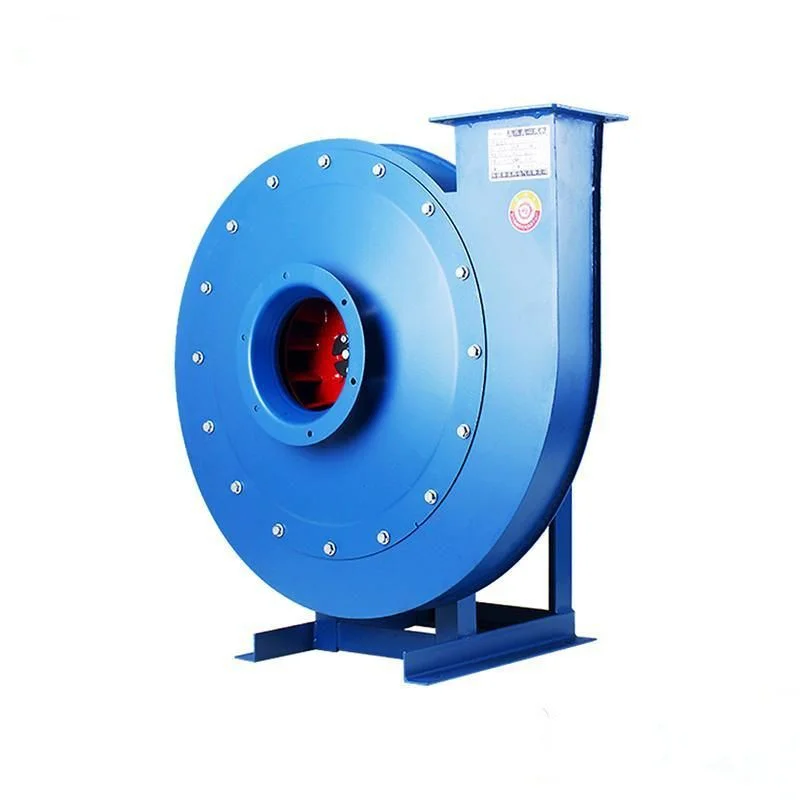
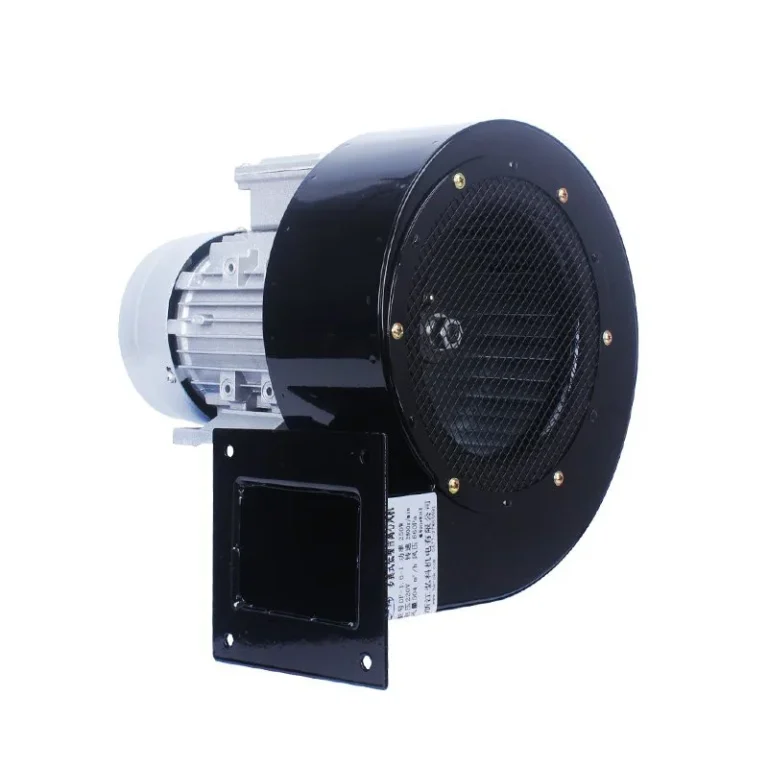
Below about 1,000 Pa the design can be generous. Impellers are wide, blades are large, speeds are moderate and the casing can be light. This is where most ventilation work sits, and it is where efficiency and noise matter more than pressure capability.
A low pressure centrifugal fan is not a compromised product; it is the right product for a system with modest resistance. Our circular duct range sits at the bottom of this band, from 68 to 451 Pa, and the AC backward curved units run 130 to 700 Pa with 85 to 300 W motors.
Between 1,000 and 3,000 Pa, most of the design decisions are still open. This is the band where filters, long duct runs and grease extract systems live, and where a 20 percent error in the estimated pressure decides between two machine sizes.
Our boiler fan series spans this range across a wide flow band, from 2,962 m3/h at 588 to 1,448 Pa up to 32,140 m3/h at 2,570 to 3,450 Pa. The same series covers a factor of ten in airflow because the machine number and the speed change, not the class.
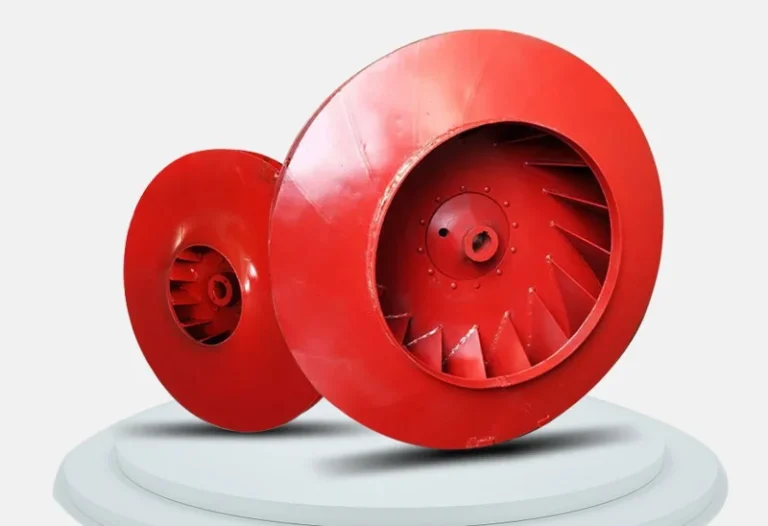
Above 3,000 Pa, the machine changes character. The impeller becomes narrow, the diameter grows to raise tip speed, and the casing has to contain a higher internal pressure without distortion. Shaft stiffness becomes critical, because a shaft that deflects under load will close the clearance between impeller and inlet and eventually touch.
Our high pressure process air fan runs from 390 to 6,978 m3/h at 1,919 to 9,149 Pa, with 0.75 to 30 kW motors at 2,900 r/min. The 3.15A machine moves 390 to 810 m3/h at 1,919 to 1,953 Pa. The 6.3A machine moves 3,220 to 6,978 m3/h at 8,148 to 9,149 Pa. Same series, three times the flow and nearly five times the pressure.
Large centrifugal fan searches usually mean something between 400 and 1,000 mm impeller diameter, driven by a motor of 15 to 75 kW. At that size three practical issues appear that smaller units never raise.
Stress in the impeller. Centrifugal stress rises with the square of tip speed, so a 1,000 mm impeller at 1,500 r/min sees tip speeds near 78 m/s, which is at the limit for ordinary steel construction. Above that, the impeller needs higher grade steel, a different blade attachment, or both.
Bearing span and shaft deflection. A large impeller is heavy, and the shaft has to carry it without whipping. That is why large units use a bearing pedestal rather than motor bearings, and why the distance between bearings is a design parameter rather than a packaging convenience.
Transport and installation. A fan with a 1,500 mm casing does not fit in a standard container assembled. It ships in sections and is assembled on site, which changes the drawing set, the packing list and the commissioning work. Ask about this before the order, not after.

Wastewater aeration is the clearest example of a duty where pressure, not airflow, defines the machine. The fan has to overcome the hydrostatic head of the water above the diffusers, typically 3 to 6 metres, which is 30 to 60 kPa before any pipe losses are added. That is beyond a single stage centrifugal fan and into rotary blower or multi-stage territory.
Aeration is also constant flow duty. The water level moves, so the pressure moves, and a fan whose flow collapses as pressure rises will starve the basin at high level. That is why aeration normally uses positive displacement or high pressure multi-stage machines, and why an aeration centrifugal fan enquiry should state the water depth and the range of level variation, not just the airflow.
The most expensive mistake in this category is not buying too little pressure, it is buying too much. A centrifugal fan selected at 6,000 Pa for a duty that needs 2,500 Pa will run well to the left of its best efficiency point, with a throttled damper, a noisy casing and a power bill that never comes down.
There is a reason buyers do it: pressure estimates are uncertain, and adding margin feels prudent. The disciplined version is to add margin to the estimate, then select a fan whose curve passes through the calculated point, so that the extra resistance the site turns out to have is absorbed by the fan’s own curve rather than by a damper. That is what the right hand side of a fan curve is for.
In practice, a 15 percent margin on the calculated system resistance is usually enough, provided the filter is sized at its dirty pressure and the duct velocity is realistic. Margins beyond that are not safety, they are a permanent efficiency penalty.
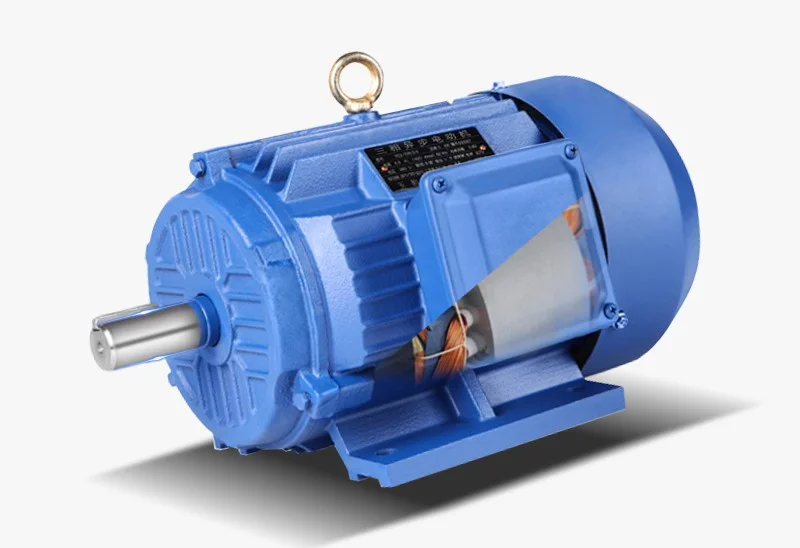
Add up the system. Straight duct at 1 Pa per metre, elbows at 30 Pa each, a clean filter at 400 to 800 Pa and a dirty one at 1,200 to 2,000 Pa, coils at 80 to 250 Pa, louvres at 30 to 80 Pa. Add 15 percent for the things you forgot, because there are always things you forgot.
If the total comes to 900 Pa, you are in the low pressure band and the selection is about efficiency and noise. At 2,000 Pa you are in the medium band and should design to the dirty filter figure. At 5,000 Pa you need a high pressure unit and a conversation about shaft and bearings. Getting that arithmetic right before the enquiry is worth more than any comparison of quotes afterwards.
Loosely, anything above 3,000 Pa total pressure. The practical marker is the hardware: a narrow impeller, a stiffer shaft and a heavier casing. Below 1,000 Pa the unit is low pressure; between the two it is medium pressure.
Not economically. Raising pressure requires a different impeller, a stiffer shaft and usually a different casing, which is a new machine rather than a modification. Running a low pressure unit faster to gain pressure will exceed its stress limits and its motor.
Because the money goes into the rotating assembly rather than the sheet metal: a heavier shaft, larger bearings, a stronger impeller and a bigger motor. Those parts are what carry the pressure, and they scale faster than the casing does.
Impellers of 2,000 mm and above exist for very high volume, low pressure duties such as mine ventilation. For high pressure work the diameter is limited by impeller stress, so large pressure duties are met with a narrower wheel at higher speed rather than a bigger one.
Yes. Pressure is proportional to air density, so a fan rated at ambient conditions produces less pressure on hot gas. A duty at 300 degrees needs correction before the catalogue figure can be applied, and that correction often moves a selection up a class.