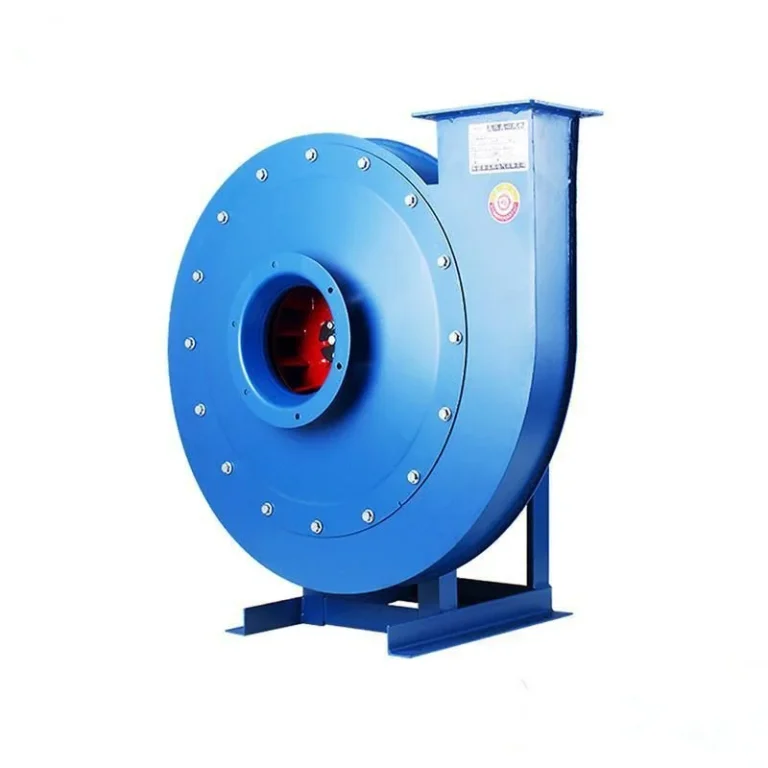
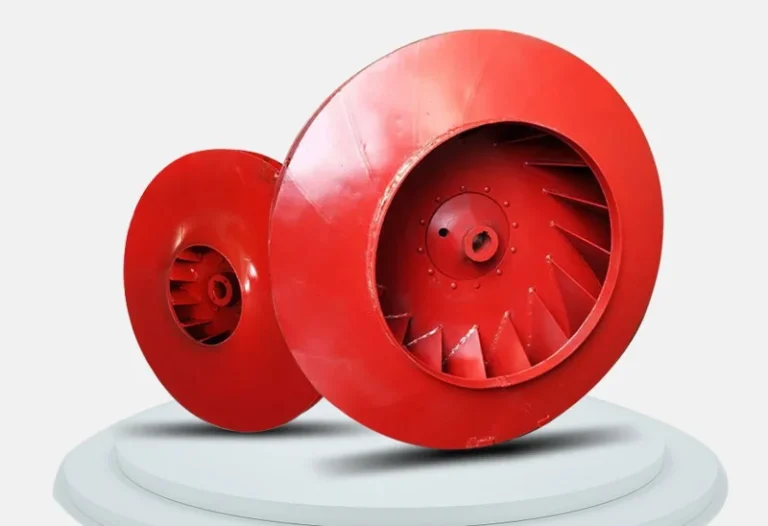
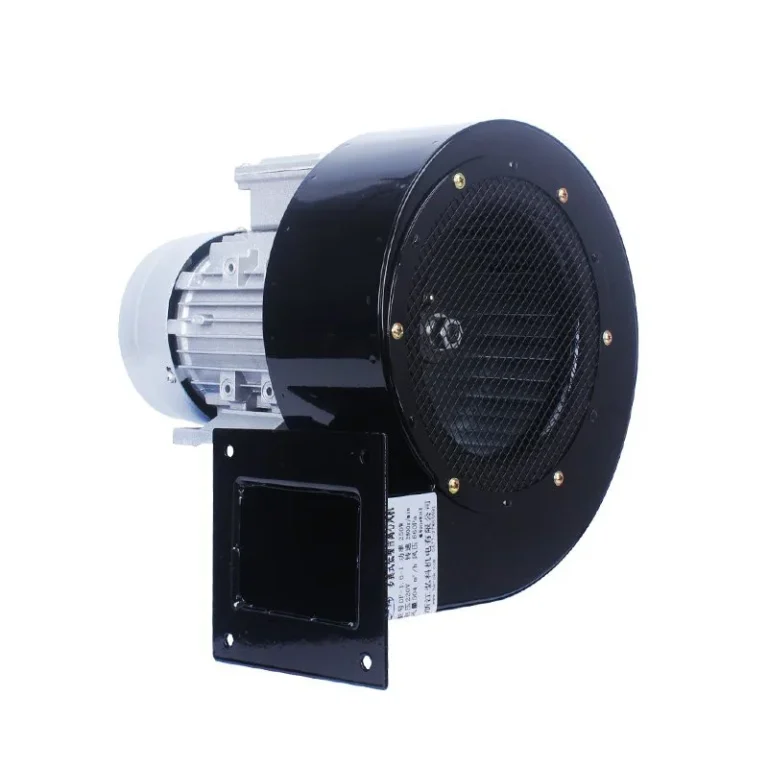
High Pressure and Low Pressure Centrifugal Fans
Pressure class decides impeller width, blade angle, casing thickness and price. How to tell which class a duty needs before a supplier picks for you.
Read More
A centrifugal fan has seven components that matter and a handful of accessories that decide whether it survives in service. Knowing what each one does is the difference between diagnosing a problem in ten minutes and replacing the whole unit because nobody could work out which part was failing.
What follows walks through the machine from the air’s point of view, then through the mechanical side, and finishes with the accessories that are usually left out of the quote and then bought in a hurry.
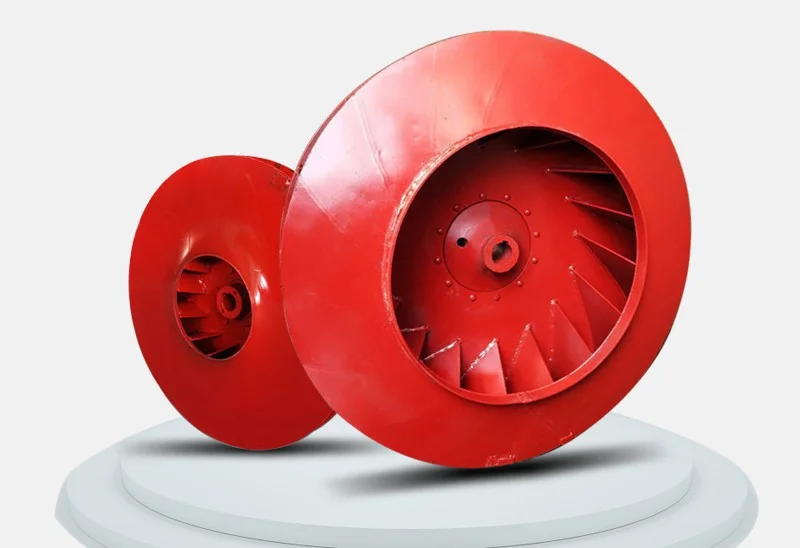
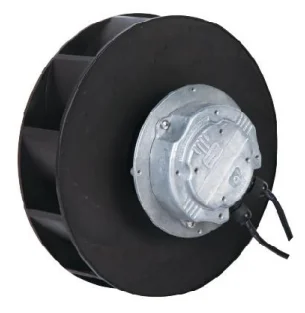
The impeller, or wheel, is the only component that does work on the air. It carries blades arranged around a central inlet eye, mounted on a backplate, sometimes with a front shroud ring. Blade shape decides the pressure and efficiency; diameter and width decide the flow; material decides the temperature and abrasion limits.
It is also the component that determines how the fan fails. An impeller that loses balance will destroy bearings; an impeller that erodes will lose performance gradually and invisibly; an impeller that is overloaded at excessive speed will fail catastrophically. Everything else in the machine exists to hold the impeller in the right place and turn it at the right speed.
The casing wraps the impeller in a spiral and turns the fast air leaving the wheel into pressure. Its cross section grows from the cut-off, the tongue of metal close to the impeller tip, around to the outlet. That growth is what slows the air and converts velocity into static pressure.
The cut-off clearance is a small dimension with a large effect. Too large and air recirculates inside the casing, cutting efficiency and raising noise. Too small and the blade passing tone becomes dominant and the fan screams. It is one of the details that separates a designed fan from an assembled one.

The inlet cone guides air from the duct into the eye with minimum turbulence. On larger units an inlet box collects air from a plenum and presents it to the cone evenly. Both are often the first components sacrificed in a cheap design, and both cause underperformance that gets blamed on the impeller.
A collapsed flexible connector, a mitred duct entering at an angle, or a plenum with no inlet box will each cost 5 to 20 percent of the fan’s rated flow. None of them will show up on a datasheet.
On a direct driven unit the impeller sits on the motor shaft and there is no separate shaft to inspect. On a belt driven unit the impeller runs on its own shaft, carried by two bearings in a pedestal, and that pedestal is the mechanical heart of the machine.
Bearing life follows the load and the speed, and load rises with impeller mass and with any residual imbalance. A fan running at 2,900 r/min with a G6.3 balanced impeller will typically give tens of thousands of hours from a quality bearing set. The same fan with a poorly balanced impeller can halve that, and the symptom is a slow rise in vibration over months rather than a sudden failure.
A belt drive uses two pulleys and a set of V-belts to set the fan speed independently of the motor speed. It is flexible, absorbs shock, and keeps the motor outside the hot airstream. It also requires alignment, tensioning and periodic replacement, and a slipped belt is the most common cause of a sudden loss of airflow on a belt driven unit.
A coupling drive connects motor and fan directly on a common base. It is quieter and needs less maintenance, at the cost of flexibility in speed selection and in motor placement.
The motor is chosen on absorbed power at duty, plus 10 to 15 percent margin, at the ambient temperature of the installation. Insulation class, IP rating, bearing type and mounting arrangement all matter, and for export the local voltage and frequency matter more than buyers expect: a motor built for 60 Hz running on 50 Hz will turn 17 percent slower, with a corresponding drop in flow and pressure.
For explosion-proof areas the motor carries the ATEX or IECEx rating, and the certificate names the exact model. Our explosion-proof range is built around that constraint rather than adapted to it.
| Accessory | Function | What goes wrong without it |
|---|---|---|
| Flexible connectors | Isolate vibration from ductwork | Vibration travels into the building structure |
| Vibration isolators | Decouple the base from the floor | Structure-borne noise, cracked grouting |
| Inlet or outlet damper | Set the operating point | Fan runs off its design duty, motor overload on forward curved units |
| Fan guard or mesh | Prevent contact with the impeller | Safety hazard, and a compliance failure |
| Filter or mesh screen | Keep debris out of the wheel | Imbalance from a single lodged fragment |
| Drain plug | Remove condensate from the casing | Corrosion, and water carried into the duct |
| Weatherproof cowl | Rain protection on outdoor units | Water ingress into the motor |
| Speed controller or drive | Match flow to demand | Throttling losses for the life of the installation |
Our fan accessories range covers guards, filters and dust covers, and the control accessories include speed and temperature controllers. They are the cheapest items on the order and the ones most often forgotten.
A centrifugal fan that matters to the process should have a spare parts list agreed at the time of order, not after the first failure. Four items cover almost every eventuality: a bearing set with the correct seals, a set of belts and a matched pulley pair on belt driven units, a flexible connector of the right size, and, for critical duty, an impeller.
Everything on that list is available on any centrifugal fan we ship, and the list should be agreed before the first failure rather than after it.
The impeller is the one buyers hesitate over, because it can be a third of the unit price. The argument for holding one is lead time rather than cost. An impeller is the longest lead item in the machine, and a spare on the shelf turns a two month outage into a two day maintenance job. For a fan on a continuous process, that calculation usually settles itself.
For the smaller end of the range the list shrinks to nothing much: a DC centrifugal blower inside an enclosure is usually replaced rather than repaired, which is why the connector and the mounting pattern matter more than the internal parts.
Bearings first, usually through imbalance or misalignment rather than through load. Belts second, through tension or pulley wear. Motors third, through heat or voltage problems rather than winding failure. Impellers last, and usually through erosion in dirty service or corrosion in wet service.
That order tells you where to spend attention on any centrifugal fan, whatever its size. A maintenance routine for a centrifugal fan is short: clean the wheel, check the belts, listen for bearing noise and review the vibration trend once or twice a year. A biannual vibration check and a belt inspection catch most failures weeks before they stop the plant, and both cost almost nothing compared with a replacement unit.
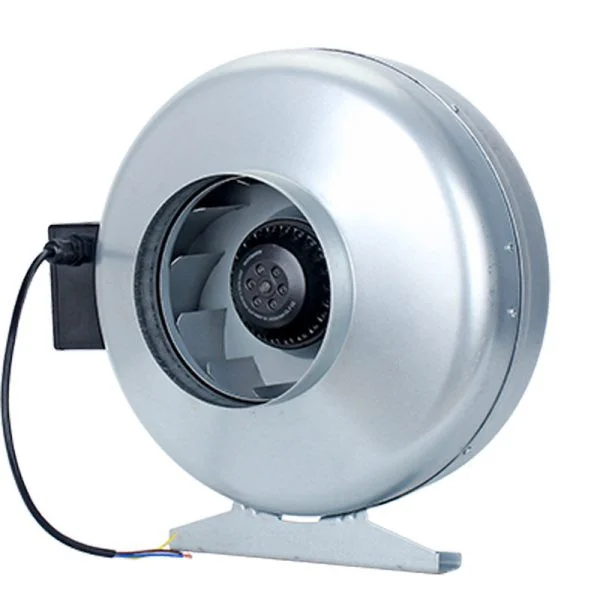
Impeller, casing or volute, inlet cone, shaft, bearings, drive and motor, plus accessories such as flexible connectors, isolators, guards, dampers and filters. The impeller is the only part that does work on the air.
Bearings, and usually because of impeller imbalance rather than because of excessive load. A dirty impeller is the most common underlying cause, which is why cleaning is a maintenance task rather than a cosmetic one.
Often yes, and it is usually the cheapest route to restoring performance when erosion has worn the blades. The new impeller must be balanced as an assembly with the existing shaft, and the casing clearance has to be checked.
It accelerates air smoothly into the impeller eye. Without it, or with a damaged one, the fan loses flow and picks up noise because the inlet becomes turbulent at the point where the air is most sensitive to disturbance.
On a cabinet blower, no. On anything above roughly 1 kW, or on any unit mounted on a lightweight structure, yes. Isolators are cheap and they prevent the building from becoming a loudspeaker.