A centrifugal fan is a machine that moves air by spinning a wheel and throwing the air outward. Air enters at the centre of the impeller, the blades accelerate it, and the scroll-shaped casing collects it and turns it through ninety degrees into the discharge. The pressure comes from centrifugal force acting on the air mass inside the wheel, not from the blades pushing air along the axis the way a propeller does.
That one mechanical fact explains most of the product. It is why a centrifugal fan generates several times the pressure of an axial fan of the same diameter. It is why the housing is bulky and the airflow leaves at a right angle instead of straight through. It is also why this is the default choice for ducted ventilation, boiler draught, process air, dust collection and anything else that has to push against resistance rather than just shift volume.
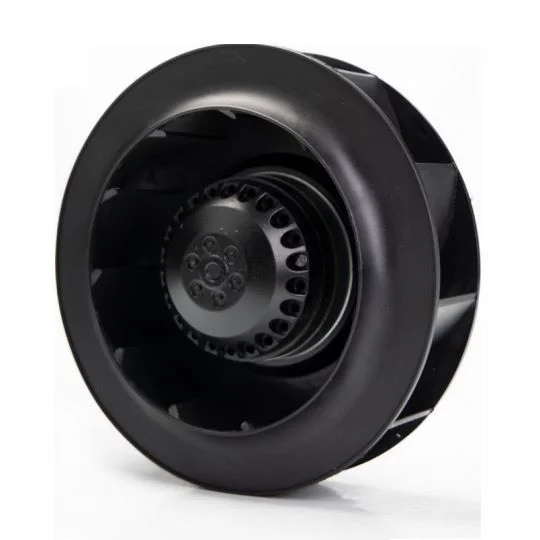
A backward curved centrifugal fan: air enters the eye at the centre and leaves through the rectangular outlet at 90 degrees.
What a centrifugal fan actually is
Strip the paint and every centrifugal fan is four things: an impeller with blades arranged around an inlet eye, a casing that wraps the impeller in a spiral, an inlet cone that guides air into the eye without turbulence, and a shaft with bearings driven by a motor. Air enters parallel to the shaft, is caught between the blades, and is flung outward. The casing slows that fast-moving air and converts velocity into static pressure before it reaches the outlet.
The important consequence is that flow and pressure are both produced by the same wheel, and they trade against each other. Close a damper on the discharge and the flow drops while the pressure rises. Open it fully and the flow rises while the pressure falls. A centrifugal fan never has one airflow figure, only a curve, and any quoted single number is a point on that curve taken at a stated resistance.
How it differs from an axial fan
Both move air, and buyers routinely compare them on airflow alone, which is the wrong comparison. The difference is in how much resistance each can overcome.
Property
Centrifugal fan
Axial fan
Air path
In at the eye, out radially, discharge at 90 degrees
Straight through, in line with the shaft
Typical pressure
300 to 15,000 Pa depending on class
30 to 800 Pa
Typical airflow
100 to 200,000 m3/h
200 to 100,000 m3/h
Behaviour against duct resistance
Holds flow as resistance rises
Flow collapses as resistance rises
Shape at equal duty
Large, boxy, needs a base
Compact, fits inside the duct
Noise character
Broadband, dominated by blade passing tone
Tonal, dominated by tip speed
Best used for
Ducted systems, filters, boilers, process air
Wall mounting, free air, condenser cooling
When somebody asks what a centrifugal fan is for, the short answer is: for moving air through something. The moment a system has a filter, a long duct run, a heat exchanger, a burner or a bed of material in the way, an axial fan stops being able to deliver and a centrifugal unit starts earning its space.
The four numbers that define any unit
Every catalogue entry, however it is laid out, is describing the same four quantities. Learning to read them in that order saves a lot of wrong orders.
Airflow, in m3/h or CFM. The volume the fan moves at the duty point. Not at free air, and not at shut-off.
Static or total pressure, in Pa or inWG. The resistance the fan can overcome at that airflow. Quoted as total pressure by most European makers and static pressure by most HVAC schedules, which is a frequent source of mismatched quotes.
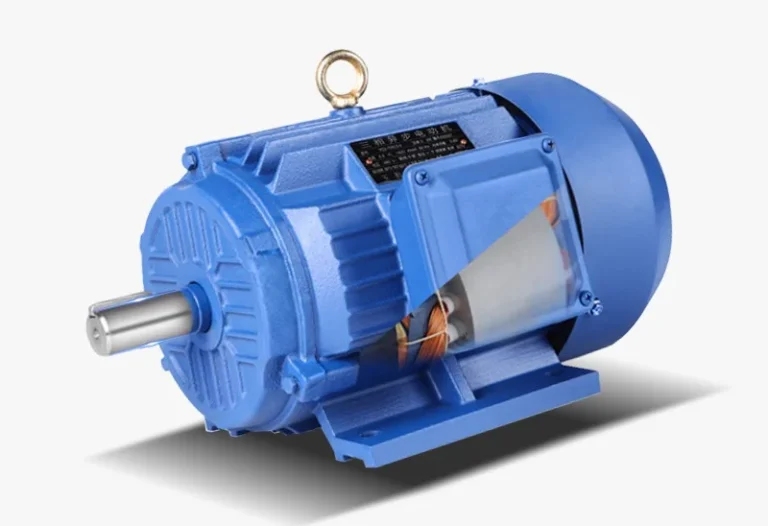
Shaft power and motor rating, in kW or HP. The power the wheel absorbs, which is always lower than the motor nameplate. A fan with a 3 kW motor may absorb 2.4 kW at duty.
Speed, in r/min. The variable that ties the other three together. Change the speed and flow follows linearly, pressure follows the square, and absorbed power follows the cube.
Where centrifugal fans are used
The application list is long, but it clusters. HVAC air handling, where the fan has to push through coils, filters and long duct runs. Boiler plants, where forced draft and induced draft fans work against the resistance of the furnace and the flue. Industrial ventilation and fume extraction in workshops and paint booths. Dust collection, where the bag filter alone can add 1,500 Pa. Kitchen exhaust, where grease filters and long horizontal runs do the same. Process air in drying, cooling and aeration, including wastewater aeration where the fan runs continuously against a water column. And equipment cooling, where a small centrifugal blower sits inside a cabinet or an analyser and pushes air through a tight internal path.
Each of those has its own temperature, dust load and duty cycle, and those three variables do more to determine the right fan than the airflow figure does.
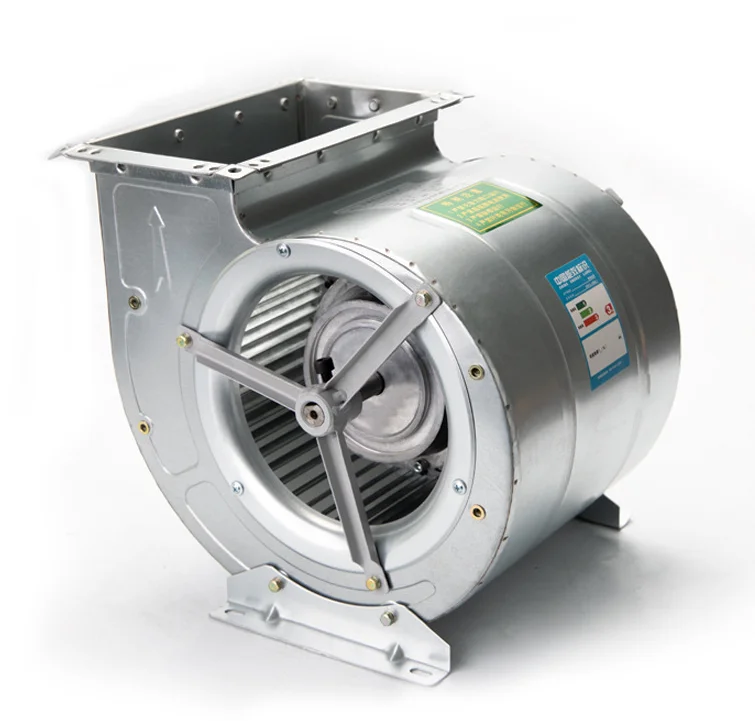
A double inlet unit for an air handling unit. Two inlet eyes share one wide impeller so the airflow spreads across a coil face.
From 100 mm cabinet blowers to 2,000 mm plant fans
Centrifugal fans span four orders of magnitude in size, and the small end is often overlooked. A cabinet blower with a 100 mm impeller moves 170 to 400 m3/h at 70 to 250 Pa and is used to cool electronics. At the other end, an industrial induced draft fan on a 100 tonne boiler moves more than 30,000 m3/h at 3,000 Pa and weighs over a tonne.
The “large centrifugal fan” searches that bring people to this page usually mean something in between: a unit with a 400 to 1,000 mm impeller, belt driven, delivering 5,000 to 40,000 m3/h for a plant room or a process line. That range is where most export enquiries sit, and where the specification work actually matters, because a 15 percent error in the pressure estimate at that size is a motor frame size and a price bracket.
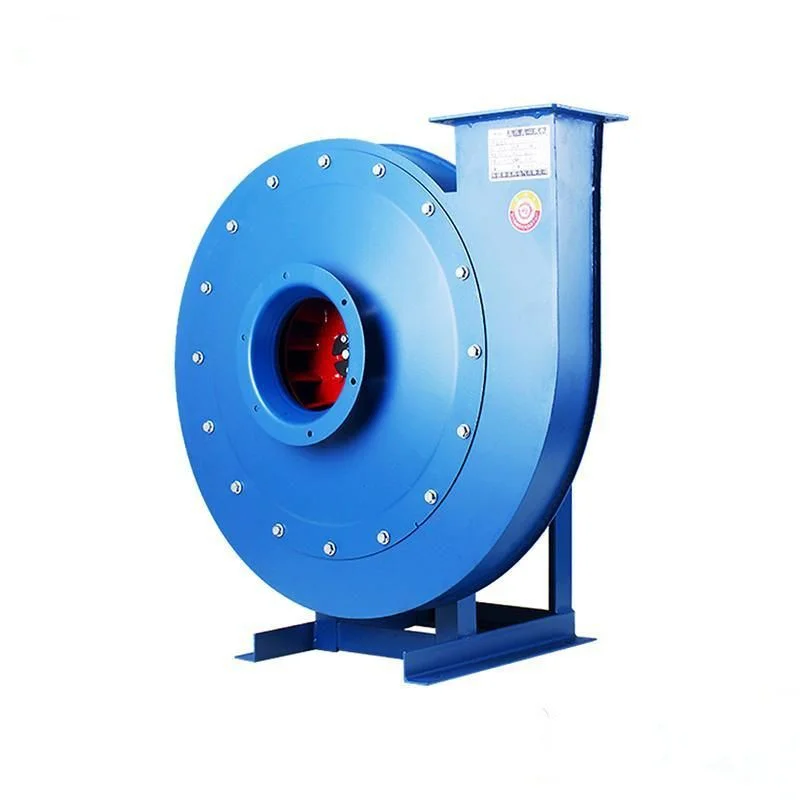
A high pressure process air unit. The narrow, large-diameter impeller is what allows 9,000 Pa at modest airflow.
What our range covers
We build centrifugal fans in six families, and it helps to see where the boundaries sit before selecting anything. The AC backward curved range covers clean air duties from 552 to 2,520 m3/h at 130 to 700 Pa with 85 to 300 W motors. The high pressure process air fan runs from 390 to 6,978 m3/h at 1,919 to 9,149 Pa, driven by 0.75 to 30 kW motors at 2,900 r/min. For hot gas there is a boiler fan series reaching 32,140 m3/h and 3,450 Pa, and a smaller Y5-47 high temperature unit for small boilers from 240 to 3,800 m3/h.
Where the air has to be divided across a wide coil face, the double inlet centrifugal fan takes over, and for tight equipment enclosures the DC centrifugal blowers handle 24 V and 48 V duties inside cabinets.
What separates a good unit from a cheap one
At quoting stage, two fans with the same airflow, pressure and motor rating can differ by a factor of two in price and by a factor of five in service life. The differences are almost never visible on the datasheet. They are in the impeller balance grade, the bearing type and clearance, the shaft material, the casing plate thickness, and whether the motor is a genuine full-power unit or a derated one that will run hot at 45 degrees ambient.
Those five items are what to ask about, in that order. A supplier who can answer them precisely is a supplier who builds fans. A supplier who answers only with a price is a trading desk, which is fine for a spare part and risky for a unit that has to run eight thousand hours a year.
Frequently asked questions
Is a centrifugal fan the same as a blower?
In trade usage, yes: a centrifugal blower and a centrifugal fan are the same machine. In engineering usage the word blower is often reserved for units that prioritise pressure over volume, such as a small high-pressure blower or a rotary lobe blower. The distinction is about duty, not about construction.
Where does the air come out of a centrifugal fan?
At 90 degrees to the inlet, through a rectangular or circular outlet on the side of the scroll casing. The exact angle of the outlet relative to the base is set by the fan’s rotation and discharge orientation, which is why those two details have to be confirmed on the order.
Can a centrifugal fan be installed in any orientation?
No. Units with sleeve bearings and units with belt drives have defined shaft positions, and large fans are usually built for one arrangement only. Rotating a fan 90 degrees after delivery can starve a bearing or flood it with oil. Confirm the mounting orientation when ordering, not on site.
How much pressure can a centrifugal fan produce?
Standard single-stage industrial units reach about 15,000 Pa. Multi-stage centrifugal blowers reach 100,000 Pa and above, but those are a different product family built around stacked impellers. For general ventilation work, anything above roughly 2,000 Pa is already in the high pressure class.
Do I need a centrifugal fan or an axial fan for a wall vent?
If the wall vent is short, straight and unobstructed, an axial fan is cheaper, smaller and quieter. If there is a louvre, a filter or more than a couple of metres of duct, the pressure drop will pull an axial fan off its curve and a centrifugal unit becomes the safer choice.
Nine checks that separate a fan that runs for fifteen years from one that fails in a season, plus what big-box listings never tell you about duty points.
Forward curved, backward curved, radial and aerofoil impellers behave very differently. A practical breakdown of centrifugal fan types and how to pick one.