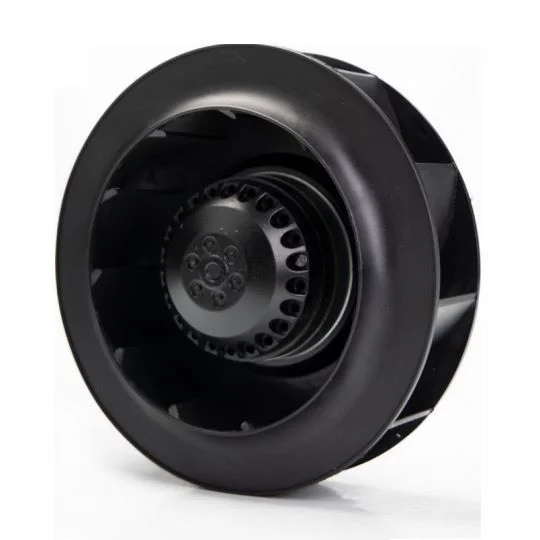
A centrifugal fan costs anywhere from about 60 US dollars for a small cabinet blower to well over 20,000 dollars for a belt-driven industrial unit with a special alloy impeller. Between those two ends the price is set by five factors, and only one of them is airflow.
Most first-time buyers assume price scales with size. It does not. A 400 mm centrifugal fan moving 3,000 m3/h at 300 Pa can cost less than half of a 315 mm centrifugal fan moving 1,500 m3/h at 6,000 Pa, because the second one has to survive forces the first never sees. Understanding that relationship is the difference between comparing quotes intelligently and comparing them by the number at the bottom.
What a centrifugal fan actually costs
The ranges below reflect what our own order book shows across export shipments in 2026, FOB, in US dollars, for standard carbon steel construction with a standard induction motor. They are ranges, not offers, and the spread inside each band is caused by the five factors in the next section.
Pressure is the expensive variable. Doubling airflow at the same pressure roughly doubles the impeller width and adds perhaps 40 to 60 percent to cost. Doubling pressure at the same airflow changes the impeller diameter, the shaft diameter, the bearing size, the casing plate thickness and usually the motor frame, and can add 150 to 250 percent.
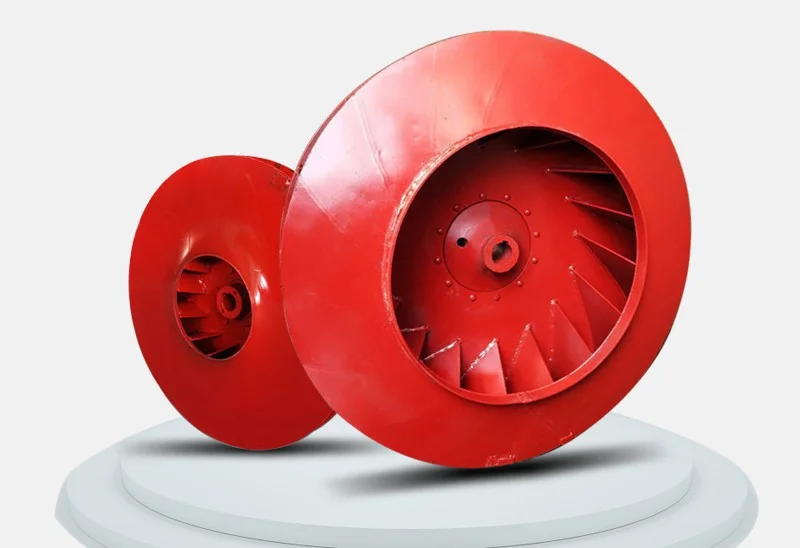
The reason is mechanical. Pressure is carried by the rotating assembly, so higher pressure means higher tip speed and higher centrifugal stress on the impeller. That stress scales with the square of tip speed, which is why a fan at 9,000 Pa needs a different shaft and bearing selection than one at 900 Pa even when the box looks similar.
Higher pressure means a heavier shaft and larger bearings. That hardware, not the sheet metal, is where the money goes.
Factor two: temperature and what it does to materials
A fan handling air at 20 degrees Celsius can be built from ordinary carbon steel with a standard motor mounted close to the casing. At 250 degrees, the impeller needs heat resistant steel, the shaft needs a cooling disc, the bearings have to be moved away from the hot zone, and the motor needs either a heat shield or a belt drive that puts it outside the airstream. Each of those steps is a cost step.
Our Y5-47 high temperature unit for small boilers is a useful illustration: the same airflow class in a standard temperature version would cost roughly 30 percent less, and the difference is entirely thermal hardware. Above 400 degrees the material conversation moves to stainless grades and the price moves with it.
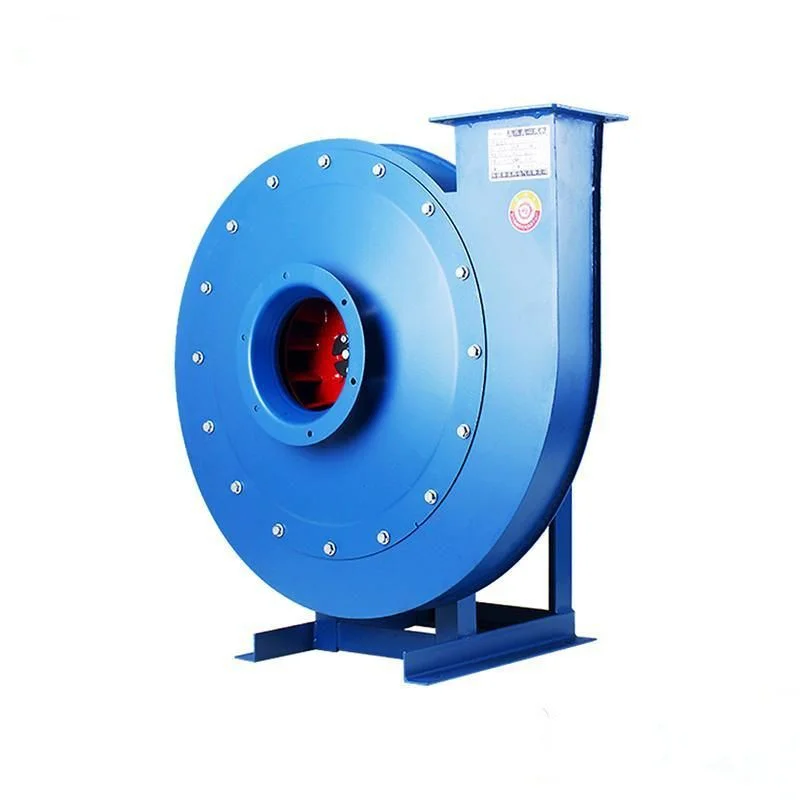
The same step change appears on the pressure side. A standard unit and a high pressure centrifugal fan for process air can share a footprint and still differ by a factor of three in price, because one carries 900 Pa and the other carries 5,000 Pa through a heavier shaft and larger bearings.
Same footprint, different duty: the high pressure unit on the right of a quote comparison usually carries the heavier rotating assembly.
Factor three: the drive arrangement
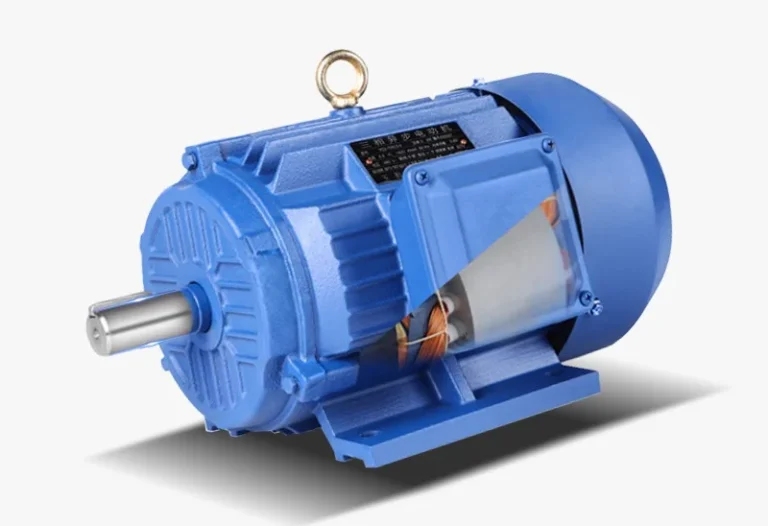
Three arrangements dominate, and they price very differently. A direct driven unit with the impeller on the motor shaft is the cheapest and covers small and medium duties. A belt driven unit adds pulleys, belts, guards, a bearing pedestal and an adjustable base, which typically adds 25 to 45 percent, but it lets the fan run at a speed the motor cannot reach and keeps the motor out of the hot air. A plug fan, with the impeller mounted directly in the air handling unit without a scroll, sits between the two.
EC drives are a separate axis. An EC backward curved fan can cost 60 to 120 percent more than the equivalent AC unit, and it earns that back through controllability and efficiency in any application that does not run at full speed all year. Our EC backward curved cooling fan is the usual comparison: 85 W at 3,096 r/min for 311 Pa, with a 0 to 10 V speed input built in.
An EC unit carries its own speed control electronics, which is where most of the price premium sits.
Factor four: materials and coatings
Carbon steel with a standard paint finish is the baseline. Epoxy coating for mildly corrosive air adds 10 to 20 percent. Stainless steel construction, whether 304 or 316, can double the price, and 316 on a large casing can do worse than that because of fabrication labour rather than material cost. Special impeller materials for abrasive dust, such as wear plates on the blade leading edge, add 15 to 30 percent and pay for themselves quickly in foundry and sand handling work.
Factor five: what is not in the box
The most common surprise in a centrifugal fan quote is not the fan. It is everything the site needs to make it run. A bare fan and a working installation differ by a starter or variable frequency drive, inlet and outlet flexible connectors, a discharge damper, a vibration isolator set, a weatherproof motor, a terminal box suitable for the local standard, and often a spare set of bearings. On a mid-range industrial unit those items can add 20 to 40 percent to the landed cost, and if they are not in the quote comparison the comparison is meaningless.
How to compare two quotes that look the same
Line up the two centrifugal fan offers on these eight points before looking at price. In our experience the cheaper offer loses on at least three of them.
Duty point: the airflow and pressure are stated at the same resistance, not free air against duty.
Motor: genuine rated output at the stated ambient, not a derated unit relabelled.
Impeller balance: grade stated, ideally G6.3 or better for anything above 3,000 r/min.
Bearings: brand and type named, not simply “NSK or equivalent”.
Casing thickness: stated in millimetres, not as “heavy gauge”.
Testing: a performance test record per unit, not a generic family curve.
Warranty: period and what it actually covers, especially bearings and motor.
Documentation: drawings, data sheet, declaration of conformity, packing list.
Our centrifugal fan range is quoted with all eight, and the quality assurance page describes the routine test each unit gets. If a competing quote cannot answer them in writing, the price gap is usually explained by the gap in the list rather than by efficiency in the factory.
Where the money is genuinely saved
Two places. The first is specifying the smallest fan that meets the duty rather than the next size up “for safety”. Oversizing by one impeller size typically costs 15 to 25 percent more and also costs running power forever. The second is buying a standard model instead of a special. A unit from an existing mould with a standard motor is dramatically cheaper than a bespoke casing built to shave 40 mm off the footprint.
Everything else in a centrifugal fan purchase is either durability or documentation, and both are worth paying for. The cheap centrifugal fan that fails in eighteen months is not cheap.
Frequently asked questions
Why is one quote three times the other for the same airflow?
Almost always pressure, temperature or material. Compare the static pressure at the duty point first, then the maximum operating temperature, then the casing material. If all three match and the prices still differ by three times, one of the two is quoting a different grade of motor and bearing.
Is a centrifugal fan cheaper than an axial fan?
Not at equal airflow and equal pressure. A centrifugal unit costs more because it has more material and a heavier rotating assembly. It becomes the cheaper option once the system needs real pressure, because an axial fan large enough to overcome that resistance costs more than the centrifugal alternative.
How much does shipping add?
For a compact unit, 5 to 12 percent of the goods value by sea. For a large industrial fan, the crate can be the dominant cost because the unit is volumetric rather than heavy, and a 2,000 mm casing may ship as a partially knocked-down assembly. Ask for the packing dimensions before comparing delivered prices.
Do EC centrifugal fans justify their premium?
If the fan runs at part speed for much of the year, yes. Power falls with the cube of speed, so a fan at 70 percent speed uses about a third of the power. If the fan runs flat out continuously, the premium is harder to recover and an AC unit with a correctly sized impeller is the better purchase.
What is the minimum order for a custom fan?
For a standard model, one unit. For a special impeller or a non-standard casing, tooling usually becomes viable at five to ten units, and below that the engineering time is priced into the unit. OEM branding on an existing model has no minimum beyond the order value that makes the paperwork worthwhile.
Nine checks that separate a fan that runs for fifteen years from one that fails in a season, plus what big-box listings never tell you about duty points.
Forward curved, backward curved, radial and aerofoil impellers behave very differently. A practical breakdown of centrifugal fan types and how to pick one.