Overview
A standard motor cools itself with a fan fixed to its own shaft. Run that motor from a drive at half speed and the fan slows with it — just when the winding needs more cooling, because low-speed operation often means high torque and high current.
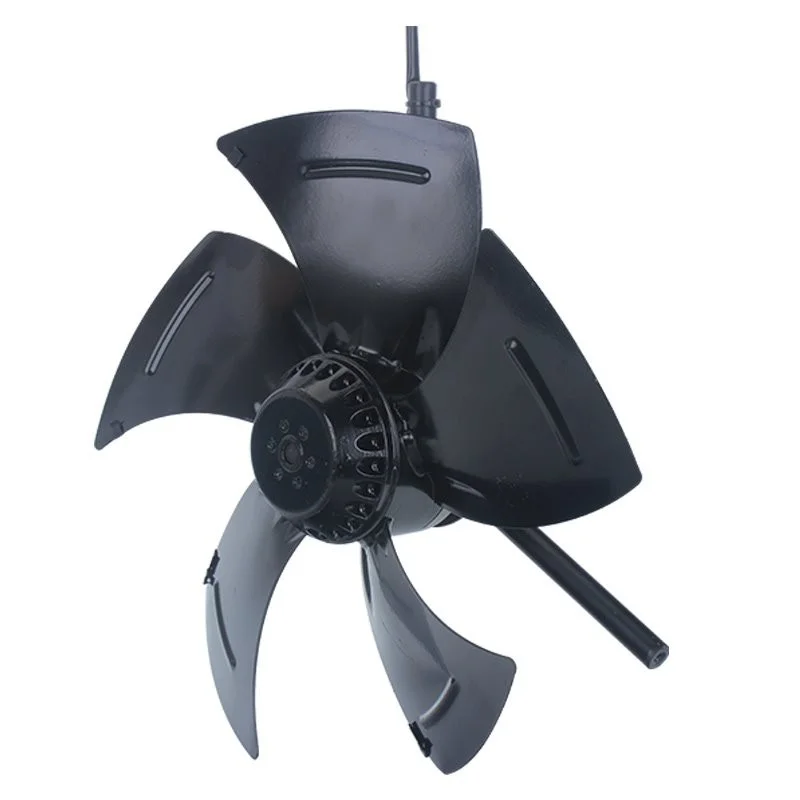
The answer is an independent fan: a small axial unit mounted in a cowl on the motor, running at full speed regardless of shaft speed. It keeps the airflow constant through the whole speed range, and it is the usual requirement for motors specified as inverter-duty.
Selection is mostly mechanical. The fan has to match the motor's frame size and cowl, and the supply has to be available separately — commonly single-phase from the panel. Tell us the frame size, the supply and the ambient temperature at the motor.
Products in This Range
-
Inverter Motor Cooling Fan with Independent Supply
G-71A- Voltage: 380 V
- Frequency: 50 Hz
Why Buy From WILMALL
Frame size matched, not guessed
We match the fan to the motor frame and cowl you name. A fan that does not seat on the cowl leaks air and cools nothing.
Separate supply planned
The fan needs its own supply and protection. We confirm where it comes from — panel, terminal box or a dedicated circuit — before quoting.
Temperature stated, not assumed
Motor-mounted fans live in hot air. The ambient at the motor, not the room, decides the bearing and insulation class.
Where It Fits
Inverter-duty motors
Motors that run below base speed for long periods, where shaft-driven cooling falls away with speed.
Servo and spindle motors
High torque at low speed in machine tools and automation, where winding temperature is the limiting factor.
Geared motors and reducers
Units that run slow and hot, needing airflow independent of the output shaft.
How to Specify
Start from the motor frame
Fan and cowl are matched to the frame size and its fixing points. Send the motor nameplate or the frame designation; a fan for a neighbouring frame will bolt on and still cool badly.
Airflow against the motor's losses
The fan has to remove the losses at the worst operating point — usually low speed, high torque. If the motor is already close to its thermal limit, a larger cowl and fan may be needed rather than a like-for-like replacement.
Supply and protection
Motor fans are often single-phase, taken from the panel with their own protection. Confirm the voltage, whether it is taken before or after the drive, and how it is switched. A fan wired to the drive output will slow with the motor — exactly what the fan is meant to avoid.
Heat, bearings and insulation
Air at the motor can be well above room temperature. Bearings and insulation have to suit it. Where the ambient is high, a ball-bearing fan with a higher insulation class is the safer choice.
Mounting direction and service
Check the airflow direction relative to the cowl and the space needed to remove the fan for service. A fan that cannot be reached becomes a motor replacement.
Questions
Why does an inverter-driven motor need a separate fan?
Because its own shaft-mounted fan slows down with the motor. At low speed the motor produces heat but receives little cooling, so an independent fan keeps the airflow constant.
How do I choose the right fan for my motor?
Start with the frame size and the cowl, then confirm the supply and the ambient temperature at the motor. Send the nameplate and we will match the fan to it.
Can the fan run from the drive output?
It can be wired that way, but then it slows with the motor and defeats the purpose. Use a separate supply, switched with the motor but not fed from the drive output.
What voltage do these fans use?
Commonly single-phase from the panel, with three-phase versions for larger frames. The exact voltage is confirmed with the motor specification.
How hot can the air at the fan be?
It depends on the bearing and insulation class. Motor-mounted positions are hotter than room ambient, so give us the measured or expected air temperature rather than the room figure.
Send the motor nameplate.
Frame size, supply and the air temperature at the motor are enough to match a fan and cowl — and to confirm it will survive the duty.