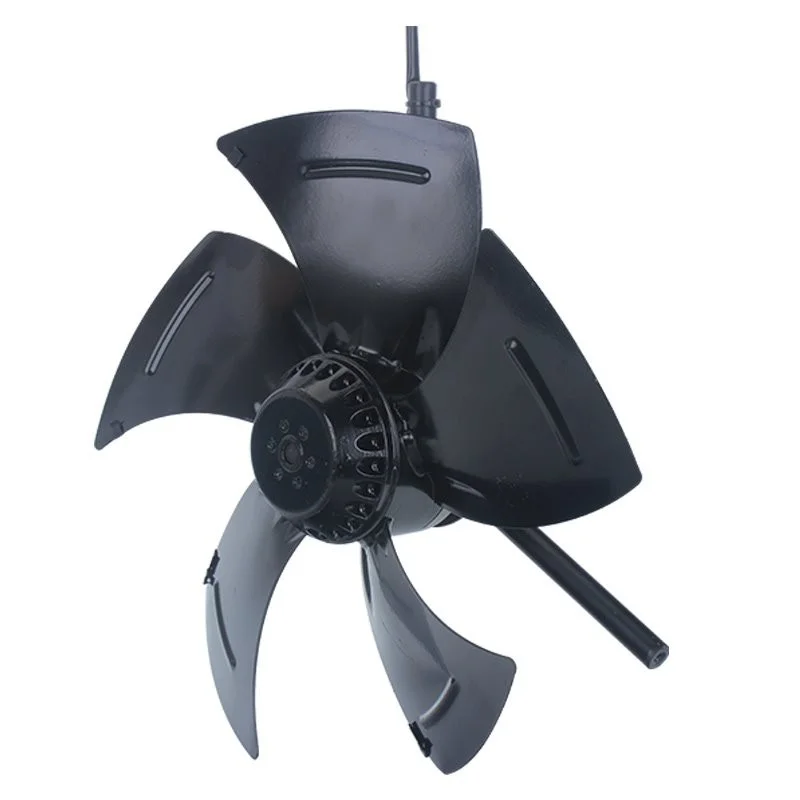

Overview
A motor that runs from a drive at low speed also turns its own shaft-mounted fan slowly, just when the winding needs more cooling. The answer is an independent fan in a cowl, running at full speed regardless of shaft speed.
This range covers fan sizes matched to motor frames, with single-phase and three-phase options. Selection is mostly mechanical: frame size, cowl, supply and the air temperature at the motor.
Where it fits
- Inverter-duty motors running below base speed
- Servo and spindle motors
- Geared motors and reducers
- Retrofit of motors that now run on a drive
Specifications
| Model | Voltage (VAC) | Frequency (Hz) | Power (W) | Current (AMP) | Rotating speed (RPM) | Air volume (M3/H) | Pressure (Pa) | Noise (dBA) | Protection Class (IP) |
|---|---|---|---|---|---|---|---|---|---|
| G-71A | 380 | 50 | 30 | 0.08 | 2800 | 300 | 50 | 55 | 54 |
| G-80A | 380 | 50 | 30 | 0.08 | 2800 | 350 | 50 | 55 | 54 |
| G-90A | 380 | 50 | 30 | 0.08 | 2800 | 500 | 80 | 55 | 54 |
| G-100A | 380 | 50 | 40 | 0.12 | 2800 | 660 | 80 | 60 | 54/55 |
| G-112A | 380 | 50 | 70 | 0.12 | 2800 | 900 | 110 | 60 | 54/55 |
| G-132A | 380 | 50 | 50 | 0.21 | 1400 | 780 | 50 | 60 | 54/55 |
| G-160A | 380 | 50 | 60 | 0.25 | 1400 | 1300 | 50 | 60 | 54/55 |
| G-180A | 380 | 50 | 80 | 0.25 | 1400 | 1300 | 50 | 60 | 54/55 |
| G-200A | 380 | 50 | 200 | 0.27 | 1400 | 2400 | 65 | 72 | 54/55 |
| G-225A | 380 | 50 | 200 | 0.37 | 1400 | 4200 | 70 | 74 | 54/55 |
| G-250A | 380 | 50 | 300 | 0.4 | 1400 | 4200 | 80 | 75 | 54/55 |
| G-280A | 380 | 50 | 450 | 0.56 | 1400 | 5000 | 85 | 78 | 54/55 |
| G-315A | 380 | 50 | 550 | 0.78 | 1400 | 5000 | 110 | 81 | 54 |
| G-355A | 380 | 50 | 600 | 1.9 | 1350 | 6500 | 150 | 85 | 54 |
Selection and installation notes
Feed the fan from a separate supply, switched with the motor but not taken from the drive output. Wired to the output, it slows with the motor and defeats the purpose.
The air at the motor is hotter than room ambient. Give us that figure, not the room temperature, when confirming the bearing and insulation.
FAQ
Why does the motor need a separate fan?
Because its own fan slows with the shaft. At low speed the motor produces heat with little cooling, so an independent fan keeps the airflow constant.
How do I match the fan to my motor?
Start from the frame size and the cowl, then confirm the supply and the ambient temperature. Send the nameplate.
Can it run from the drive output?
It can be wired that way, but then it slows with the motor. Use a separate supply instead.
Which voltages are available?
Single-phase and three-phase options, confirmed against the motor specification.
Request Quote
Interested in this product? Share your requirements or questions using the form.
-
Your requirements
Include the specifications, options, or quantity you need, if known.
-
Your questions
Ask about product details, availability, or order information.
-
Your contact details
Leave an email address where you can receive a reply.