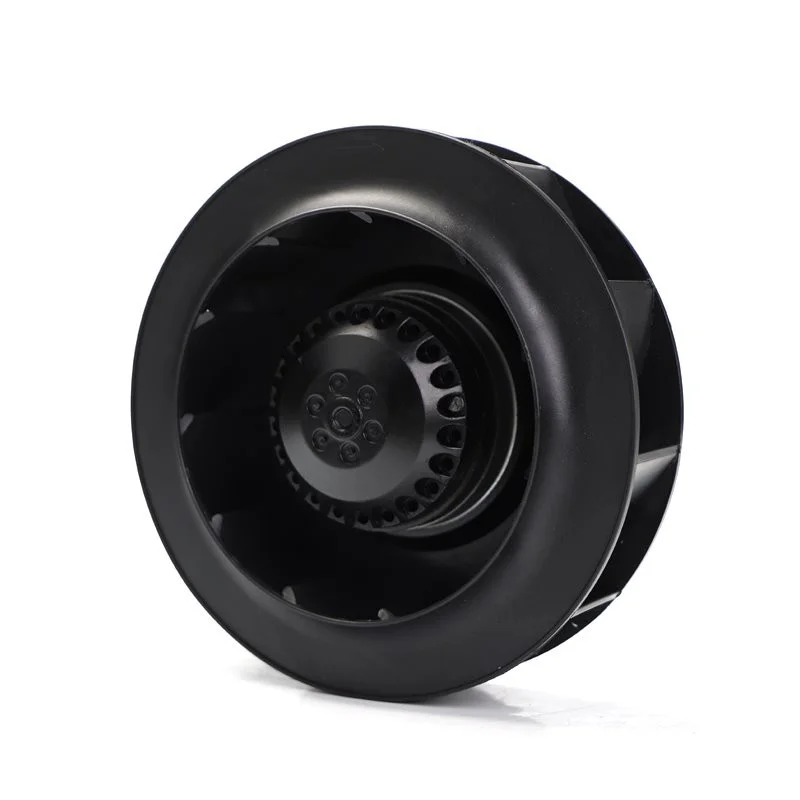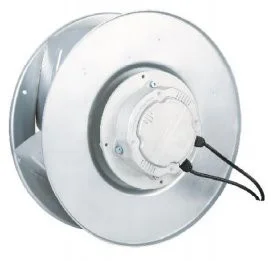
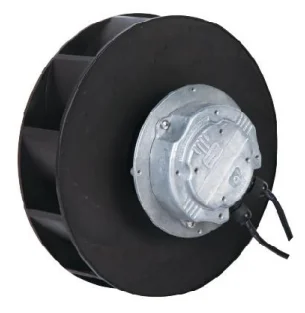

Overview
A backward-curved impeller driven by an EC motor: pressure from the wheel, efficiency and control from the electronics. Speed follows a 0–10 V or PWM signal rather than a voltage controller, and part-load efficiency stays high.
It suits ducted cooling and equipment rooms that run for long hours. The premium over an AC fan is recovered through running hours, not through the purchase price.
Where it fits
- Ducted equipment cooling
- Clean rooms and treatment units
- Continuous extract with variable demand
- Retrofit of throttled AC systems
Specifications
| Model | Voltage(V) | Frequency(Hz) | Power(W) | Rotating speed(r/min) | Current(A) | Static pressure(Pa) | Static pressure efficiency(%) | EFF Grade(N) | Noise( dB(A) ) |
|---|---|---|---|---|---|---|---|---|---|
| PMDWF74L25-190×62 | 1~230±10% | 50/60 | 85 | 3096 | 0.2 | 311 | 35.85 | 58 | 68 |
Selection and installation notes
Confirm the control signal at the site. EC fans do not respond to a dimmer, and a 0–10 V unit will not work on a PWM output.
Keep the electronics out of hot air. The controller is the heat-sensitive part and derates before the motor does.
FAQ
How is speed controlled?
By 0–10 V or PWM, depending on the model. Check what the controller or BMS provides before ordering.
Is EC worth the extra cost?
Where the fan runs long hours at reduced speed. For short on/off duty, AC is usually the better value.
Can it replace an AC fan?
Often, if the opening and duct match. The wiring differs: permanent supply plus a control signal.
What if the electronics fail?
The fan is replaced as a unit. Keep the model and control configuration for spares.
Request Quote
Interested in this product? Share your requirements or questions using the form.
-
Your requirements
Include the specifications, options, or quantity you need, if known.
-
Your questions
Ask about product details, availability, or order information.
-
Your contact details
Leave an email address where you can receive a reply.